


I was scrolling a digital nomad group—the kind where people post co-working recommendations and “visa hacks”—when a job listing stopped me cold:
“If you are in Valencia and either (1) have your own application that uses GenAI in its back-end, rather than just using GenAI to develop it, or (2) have developed such complex application and can prove you did it—please DM me for a work opportunity.”
Read it again. Notice the parenthetical: “rather than just using GenAI to develop it.”
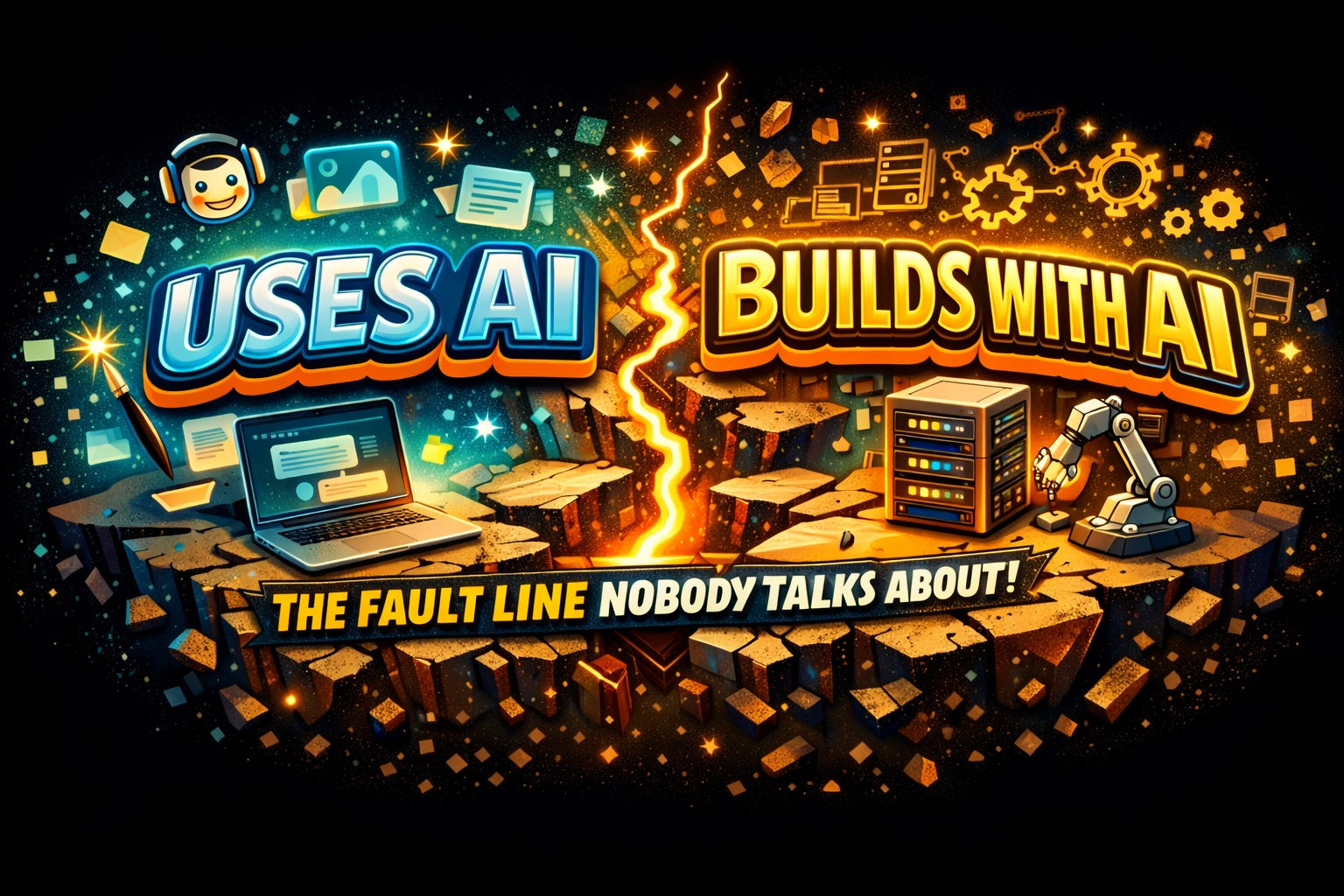
That single clause is doing more analytical work than most AI trend reports published this quarter. It draws a line. On one side: people who use AI tools—prompt, generate, automate fragments of their workflow. On the other: people who build with AI—who architect systems where a model is a structural component, not a convenience layer.
This isn’t a technical distinction. It’s a market fault line. And if you’re a creative professional, a strategist, a consultant, or anyone currently navigating the AI landscape from the outside in—the side you’re standing on is about to matter a lot more than your LinkedIn bio suggests.
* * *
1. Two Types of People in AI
Here’s the taxonomy I keep coming back to. It’s crude, but it’s honest.
Category A: Uses AI. You prompt ChatGPT for copy. You generate images in Midjourney. You run meeting transcripts through an AI summarizer. You are a consumer of AI outputs. Your workflow got faster, maybe 20–40% on certain tasks. You tell people you’re “working with AI.” And technically, you are.
Category B: Builds with AI. You’ve integrated a language model into a product’s back-end. You’ve designed an architecture where the model handles specific tasks within a pipeline—classification, extraction, generation, decision support—not as a chatbot, but as a functional component. You’ve dealt with context windows, token costs, latency, hallucination management, and model selection. You didn’t just use an API. You built something around it.
The job post in that nomad group wasn’t looking for Category A. It was explicitly filtering for Category B. And that filter is spreading.
Six months ago, “I use AI daily” was a differentiator on a resume. Today, it’s table stakes—the equivalent of “proficient in Microsoft Office” circa 2009. The market is recalibrating. Fast.
The question is no longer whether you use AI. It’s whether AI uses you—or whether you’ve taught it to do something it couldn’t do without your architecture.
* * *
2. Why Wrappers Die
To understand where this fault line comes from, you need to understand the word that professional AI circles now use as a pejorative: wrapper.
A wrapper is a product that puts a user interface on top of someone else’s model. Chat with your PDF. Summarize your emails. Generate social media posts from a brief. In 2023, this was a legitimate startup play. You could raise seed funding on the back of a GPT-4 integration and a clean UI.
In 2026, the term “wrapper” has become a verdict. Here’s why.
The Sherlocking problem. Every time OpenAI, Google, or Anthropic ships an update, they absorb features that wrappers were selling. Your “summarize this document” tool? It’s now a native feature in the model’s own interface. Your UI wasn’t the product. It was a temporary gap in someone else’s roadmap.
The commoditization of models. The model itself—GPT, Claude, Gemini, Llama, DeepSeek—is increasingly a commodity. Like electricity. You don’t build a business on the fact that you have access to electricity. You build it on what you do with the power.
The interface mismatch. There’s a growing argument in HCI (human-computer interaction) circles that the chat interface is the worst possible way to interact with AI. It places the cognitive load on the user: you have to know what to ask, how to ask it, and how to evaluate the answer. The future isn’t “talk to AI.” It’s AI embedded invisibly into tools you already use—your CRM, your design software, your project management stack—doing work without being asked.
The analogy I keep using with clients: imagine a designer who sells access to Figma. Not a design service. Not a design system. Just a login to Figma with a nicer landing page. That’s what a thin wrapper is. You’re not a business. You’re a reseller of someone else’s capability with a markup and a prayer.
* * *
3. What IS a Business, Then?
If wrappers are dying, what survives? Three things. All of them require going deeper than an API key.
Proprietary data as moat. The model is the engine. Your data is the fuel the engine can’t get anywhere else. A legal-tech tool built on top of GPT is a wrapper. A legal-tech tool trained on 15 years of Spanish contract law precedents, integrated with local court filing systems, and serving lawyers who trust it because it speaks their regulatory language—that’s a product. The model provides reasoning. The data provides irreplaceability.
Spain’s legal system is specific enough that OpenAI won’t build for it any time soon. Ukraine’s defense-tech and OSINT ecosystem runs on operational data that no foundation model will ever have access to. These are “right” wrappers—where local context creates a moat that global platforms can’t cross quickly.
Workflow integration as moat. Being inside the user’s daily process is worth more than being the best model. Notion’s AI isn’t the smartest. But it’s embedded in where people already work, and switching costs are enormous. The product isn’t the AI. The product is the AI plus the context of everything you’ve already built inside the platform.
Trust architecture as moat. This is the one nobody in tech talks about, but every branding professional understands instinctively. In a world where every tool has access to the same underlying models, the differentiator becomes: who do I trust with my business context? Who has earned the right to see my internal data, my strategy documents, my messy first drafts? Trust isn’t a feature you ship. It’s an asset you build over months of demonstrated competence. And it’s the one moat that can’t be copied by a better-funded competitor overnight.
In a world of commoditized intelligence, the moat isn’t the algorithm. It’s the data you’ve earned the right to hold, the workflow you’re embedded in, and the trust you’ve built around both.
* * *
4. Switcher’s Compass: How I Navigate This
I spent more than 17 years building brands, training creative teams, co-founding an academy. Now I’m inside a master’s program in AI Product Management, reading papers on lattice vector quantization and agentic workflows. I am, by every definition, a switcher—someone crossing from one professional world into another.
And the most useful thing I’ve developed in this crossing isn’t a technical skill. It’s a set of questions I ask myself when I encounter any AI product, opportunity, or hype wave. Call it a compass. Here’s what’s on it.
Question 1: If the model provider ships this feature tomorrow, does the product still exist? This is the wrapper test. If OpenAI adding a button kills your startup, you never had a startup. You had a feature request that OpenAI hadn’t prioritized yet.
Question 2: Where’s the data that the model can’t get on its own? Every defensible AI product I’ve seen has a data layer that isn’t in the training set. Industry-specific. Client-specific. Geography-specific. Operationally specific. If the answer is “nowhere—we use the general model,” that’s a red flag.
Question 3: Does this reduce cognitive load, or just shift it? Most AI tools I evaluate don’t eliminate work. They move it. Instead of writing, you’re editing. Instead of researching, you’re verifying. Instead of thinking, you’re prompting. The genuinely valuable products are the ones where the user’s effort goes down, not sideways. They don’t ask you to become a prompt engineer. They ask you to press a button and trust the system.
Question 4: Am I learning, or am I outsourcing my thinking? This one’s personal. I came from an industry where the quality of your thinking was the product. When I use AI to write a first draft, am I getting faster—or am I getting lazier? There’s research now (CHI 2025) showing that AI-assisted creative work can atrophy your independent creative ability over time. The tool makes you better while you’re using it, and worse when you’re not. That’s not a tool. That’s a dependency. I watch for this constantly.
Question 5: Would I bet my reputation on this output? The ultimate quality filter. If a piece of AI-generated work went out to a client with my name on it and no human edit—would I be comfortable? If the answer is no, the AI isn’t ready for that task. And if I’m editing 80% of it anyway, I need to be honest about where the real value is coming from.
These five questions won’t make you a machine learning engineer. They’re not meant to. They’re meant to keep you from being a passive passenger in a market that’s moving faster than most people’s ability to assess it.
* * *
The Fault Line Is a Mirror
Back to that job post.
A year from now, the distinction it draws—between using AI and building with AI—will not be a niche hiring filter in a nomad group. It will be a standard screening question across industries. Not because everyone needs to be an engineer. But because the market will increasingly demand that professionals understand the architecture of the tools shaping their work, not just the interface.
I say this as someone who is still learning the architecture. I’m not writing from the other side of the fault line. I’m writing from the middle of it. Every week I understand a little more about how models work, how products are built around them, how the infrastructure underneath is evolving. And every week I also see how my 17 years in creative strategy give me a lens that pure technologists don’t have—because I know what trust looks like to a client, what brand coherence costs to build, and why “creative AI” is two words that most people haven’t thought about carefully enough.
The fault line isn’t just between two types of professionals. It’s between two attitudes toward the same technology: passive consumption and active construction.
The question isn’t which side you’re on today. It’s whether you’re moving.
Serhey Vovk is the founder of VOVK (Creative) Consulting and co-founder of Kyiv Academy of Media Arts (KAMA). He writes about what happens when the creative industry learns to speak machine at aibubbledotcom.com.
Great read! I'm starting an AI course for product managers next week and can't wait to build my first agent. Owning two agencies, I'm automating our workflows with agents—starting by analyzing client briefs and checking if proposals meet criteria, plus dashboards for sales funnels and financials. For my new startup, I've hired an AI architect to design an agent that parses a UK startups PDF report, crafts personalized outreach messages with demo CTAs, and tests my MVP. Exciting times—thanks for the thoughtful piece that got me fired up to build!