


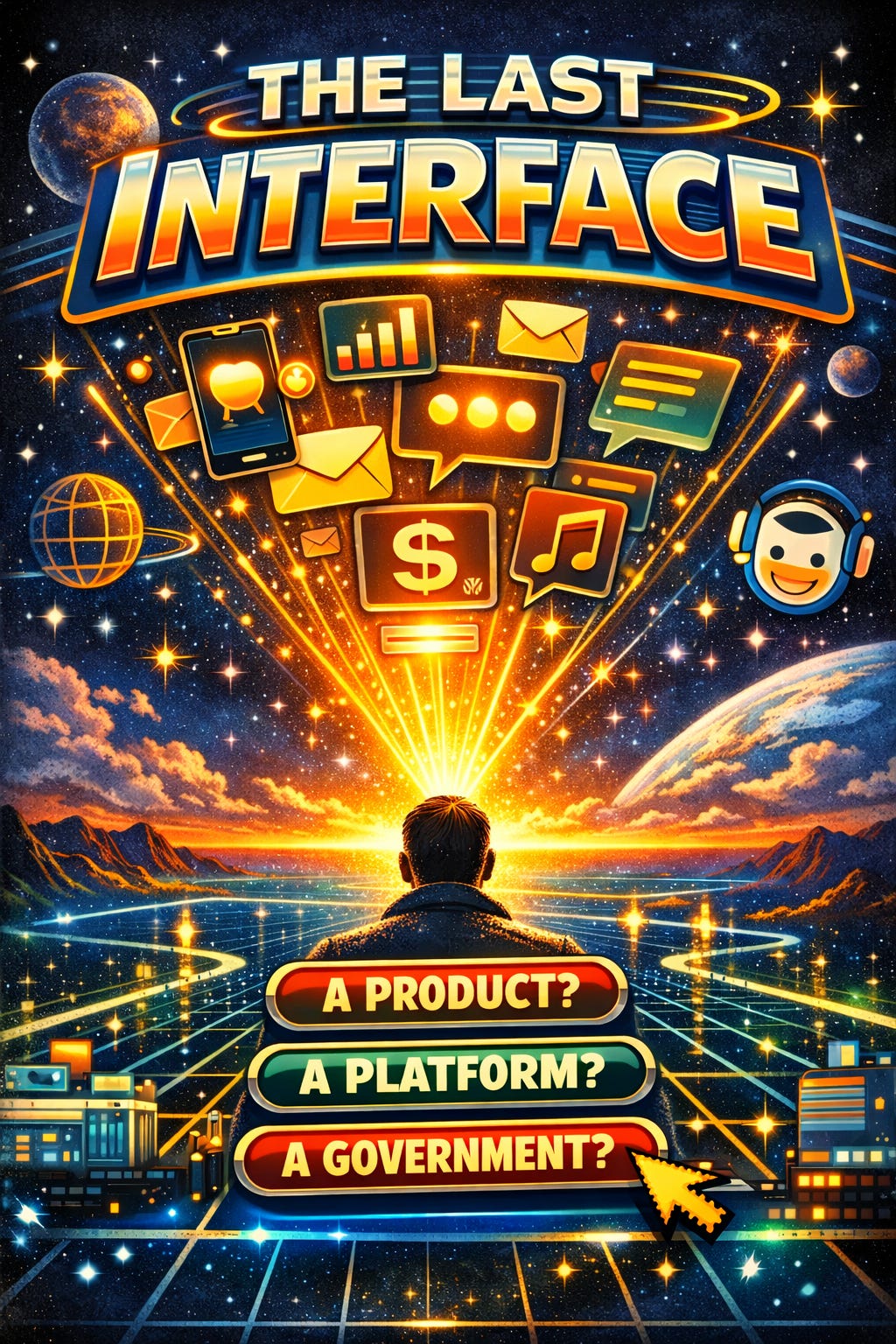
The Vanishing
I didn’t plan to stop using my browser. It just happened.
A few weeks ago, I opened my laptop to check something — an email thread, a flight price, a fact I needed for a piece I was writing. Standard Tuesday morning. Except somewhere between the intention and the action, I realized I’d already done all of it. Inside a single conversation window. No Chrome. No Gmail tab. No toggling between six apps like a pianist playing separate instruments with each finger.
The browser didn’t crash. It didn’t freeze. It just… became unnecessary.
Sit with that for a second. Because this isn’t a story about one person’s workflow getting slightly more efficient. This is a story about the most fundamental change in how humans interact with computers since the graphical user interface shipped in 1984. And it’s happening right now, on your machine and mine.
You’re probably already feeling it. Even if you haven’t named it yet.
* * *
The Screen You Stopped Seeing
Let me describe your day. Tell me if this sounds familiar.
You wake up. You check your phone. Not for one thing — for a cascade of things routed through a cascade of apps. Messages here. Email there. Calendar somewhere else. News in a fifth place. Weather in a sixth. You haven’t brushed your teeth and you’ve already performed fifteen context switches across six interfaces, each designed by a different company, each demanding you learn its grammar, remember its layout, tolerate its ads.
Multiply that by a workday. Slack for messaging. Notion for docs. Google for search. Figma for design. Jira for tasks. Zoom for calls. Each one is a toll booth between your intention and its execution. You don’t think of it that way because you’ve been trained, over two decades of smartphone culture, to accept fragmentation as the price of digital life.
But it’s not a law of nature. It’s a business model.
Every app exists because a company claimed one slice of your intent and built a walled garden around it. Uber owns your ride. Gmail owns your inbox. Spotify owns your music. Each one said: “To do this one thing, you must enter our space, on our terms, through our door.” And for fifteen years, we complied. Because there was no alternative.
That alternative is arriving. And it looks nothing like an app.
* * *
A 35-Year-Old Prophecy Coming True in the Wrong Order
In 1991, a computer scientist named Mark Weiser published a paper in Scientific American called “The Computer for the 21st Century.” He was CTO of Xerox PARC — the lab that invented the modern desktop, the mouse, and ethernet. And he was already tired of all of it.
Weiser’s thesis was deceptively simple: the most profound technologies are those that disappear. They weave into the fabric of everyday life until they’re indistinguishable from it. Writing was his example — once a rare, expensive, tightly controlled technology, now so ubiquitous you don’t notice the text on a candy wrapper. He wanted computers to follow the same arc. Not bigger screens. Not more personal devices. Invisible computing, woven into the environment, requiring zero attention.
He called it “ubiquitous computing.” Then, with John Seely Brown, he gave it a more poetic name: calm technology. Technology that informs but doesn’t demand your focus.
Weiser died in 1999. Before the iPhone. Before apps. Before the attention economy turned his vision inside out. Instead of calm, we got chaos. Instead of invisible, we got screens competing for every second of our waking lives. The entire arc of consumer technology from 2007 to 2024 was the opposite of what he proposed: louder, brighter, stickier, more demanding.
Here’s the twist. In 2026, Weiser’s prophecy is finally coming true. Just not the way he imagined.
It’s not arriving through smart walls and embedded sensors. It’s arriving through language.
* * *
The Instruct/Verify Era
The HCI field — Human-Computer Interaction, the discipline that studies how people and machines communicate — has names for what’s emerging. Several names, because the field loves a good taxonomy war.
Ambient intelligence — context-aware environments that anticipate needs without explicit commands. The convergence of AI, IoT, and edge computing into systems that sense, adapt, and respond. The global market hit $36 billion in 2025. Projected: over $440 billion by 2034, growing at 25%+ annually. That’s not a forecast. That’s a gravitational field.
Zero UI / The Invisible Interface — the design philosophy that the best interface is no interface at all. At CES 2026, this wasn’t a panel topic. It was the premise of the entire show. The conversation shifted from “AI as a feature” to “AI as the environment.”
Agentic AI — systems that don’t just generate text but execute actions autonomously. Book flights. File reports. Navigate APIs. Gartner projects 40% of enterprise applications will embed task-specific AI agents by end of 2026. IDC says AI copilots will land in 80% of enterprise workplace apps. The paradigm shifts from “ask and receive” to “command and execute.”
But forget the taxonomy for a moment. Here’s what’s happening on the ground.
Carl Pei, CEO of Nothing, stood at SXSW three weeks ago and said apps will become obsolete. His example: meeting a friend for coffee currently requires launching four separate apps — messaging, maps, ride-hailing, calendar. A single AI agent should resolve the entire intent in one sentence. Nothing raised $200 million on this thesis.
In January 2026 alone, $2 trillion in SaaS market capitalization evaporated. Not a correction. Structural disruption. When one AI agent replaces dozens of software licenses, the per-seat pricing model that built an entire industry starts to collapse.
The industry phrase catching on: we’re entering the “Instruct/Verify” era. You state intent in natural language. The system executes. You verify the result. That’s the loop. Everything else — navigation, clicking, switching, searching — disappears.
Everything else disappears.
* * *
The Race to Build the Last Device
If the software layer is collapsing into a single conversational interface, the hardware question follows: what do you hold? Wear? Place in your room?
The answers are already in prototype.
OpenAI + Jony Ive are building a screenless AI device codenamed “Sweetpea.” A pill-shaped wearable that hooks behind the ear. No display. No keyboard. Voice, sensors, contextual awareness. Custom 2nm chip. Manufactured by Foxconn. Target: 40–50 million units in year one. Launch: second half of 2026. Altman calls it “more peaceful than a smartphone.” The man who built ChatGPT is betting the next interface has no screen at all.
Apple is developing three AI wearable categories simultaneously: smart glasses (codename N50, production by December 2026, launch 2027), an AI pendant with dual cameras and microphones, and camera-equipped AirPods. All built around a radically overhauled Siri — retooled as a conversational chatbot powered by models co-developed with Google. iOS 27, shipping later this year, debuts this new Siri. Apple is accelerating because it knows: if someone else builds the last interface first, the iPhone becomes a peripheral.
Meta’s Ray-Ban smart glasses are in market and gaining traction. No screen. Voice-first. Camera-equipped. They work because glasses are something people already wear — and the AI makes them useful enough to become necessary. For vision-impaired users, they read signs and describe surroundings. For everyone else, the first mass-market proof that screenless AI works in daily life.
The pattern: every major player converges on the same thesis — screenless, voice-first, context-aware, always present. The interface dissolves. The machine becomes an ambient companion.
Weiser’s calm technology. Except it’s not in the walls. It’s in your ear.
* * *
The Trillion-Dollar Funnel
Now for the part that should make you uncomfortable.
Right now, your digital life is fragmented across 40+ apps because each company controls one slice of your intent. That fragmentation is annoying — but it’s also a form of distributed power. No single entity owns your entire digital existence. You choose your email provider, your music service, your ride-hailing app, your bank. The friction is real. So is the freedom.
The moment one entity provides a single natural-language layer that executes across all domains, the power dynamics invert.
You don’t need Uber’s app if your agent books rides. You don’t need Gmail if your agent handles mail. You don’t need a browser if your agent fetches and acts. You don’t need a screen if your agent speaks results into your ear.
Each sentence eliminates a multi-billion-dollar industry. And funnels its value into a single chokepoint: the conversational layer.
Whoever owns the last interface owns the relationship between humanity and its tools.
The contenders:
Apple — ecosystem lock-in, a billion active devices, hardware-software integration nobody matches. If Siri becomes genuinely intelligent, Apple controls the full vertical: chip, device, OS, agent.
Google — data, infrastructure, models. Search was already the closest thing to a universal intent layer. Gemini is their bet that conversational AI replaces the search bar — and with it, the browser, the web, the entire architecture of information flow.
OpenAI — models, distribution (300+ million ChatGPT users), and now hardware via Ive. No ecosystem yet. Building one from zero. The audacity is staggering: they’re trying to leapfrog the smartphone entirely.
Meta — social graph plus a head start on wearable AI people actually use. The Ray-Ban glasses are quietly becoming the Trojan horse.
Anthropic — building the deepest integrations into professional workflows: email, calendar, documents, Slack, code. Not hardware. Not consumer devices. The workplace as the entry point.
Five companies. Five strategies. One prize. Not market share. The funnel through which all human digital intent passes. A position so powerful it makes Google’s search monopoly look like a regional advantage.
* * *
The Oxygen Problem
Mark Weiser wanted technology to be like literacy: everywhere, invisible, calm.
What we might get instead is technology like oxygen: everywhere, invisible — and controlled by whoever owns the supply.
In the app era, if Uber annoyed you, you switched to Lyft. If Gmail felt invasive, you moved to ProtonMail. The exits existed because the interfaces were separate. Competition happened at the app level.
In the single-interface era, what does “switching” even mean? If your AI agent handles everything — rides, email, shopping, banking, health, work — the switching cost isn’t inconvenience. It’s identity loss. The agent knows your preferences, your history, your patterns, your relationships. Leaving it means leaving yourself behind.
We’ve seen this before. Social media created it with social graphs. Cloud storage created it with data gravity. But a universal AI agent creates something qualitatively different: cognitive lock-in. Not your files or friends. Your decision-making apparatus.
The antitrust framework doesn’t have vocabulary for this yet. Regulators think in “markets” and “competitors.” But when one company becomes the medium through which a person interacts with reality, market is no longer the right word.
Platform isn’t the right word either.
* * *
When, Not If
A realistic timeline — not from futurist keynotes, but from product roadmaps and supply chains:
2026 (now): OpenAI’s Sweetpea debuts. Apple ships chatbot-Siri in iOS 27. AI agents handle multi-step tasks in professional tools. Browser usage begins measurable decline among power users. You notice you open fewer apps per day. The Instruct/Verify loop becomes default for routine tasks.
2027: Apple launches glasses and pendant. Second-gen screenless devices arrive. Voice-first becomes normal in professional settings. The first major app companies report declining DAU — not because users left, but because agents replaced the need to open the app.
2028–2029: Consolidation. One or two companies emerge as the dominant conversational layer. Regulatory battles begin. The phrase “cognitive infrastructure” enters policy debates. The smartphone doesn’t die — it becomes a battery and antenna for the wearable that handles everything else.
2030+: The interface disappears for most daily tasks. Computing becomes ambient in the Weiser sense — but concentrated in a way he never envisioned. The question is no longer technology. It’s governance.
* * *
The Translator’s Take
I’m watching this from both sides of the stack.
For 17 years, I built brands inside a world where the medium shaped the message. You designed for screens, for scroll, for tap. The interface was the canvas. Now I’m inside AI product thinking, and I see the canvas dissolving in real time.
Personally? The number of apps I open per day is declining — not by design, but because the conversational layer absorbs their functions. Email, search, scheduling, writing, research, code. One window. I catch myself reaching for a browser and then not reaching, because the answer is already in front of me.
It’s faster. It’s calmer. It’s better. And that’s exactly what makes the monopoly question so urgent.
Because the best monopolies don’t feel like monopolies. They feel like convenience. Like relief. Like progress. You don’t fight them because fighting means going back to the friction, the fragmentation, the fifteen-app Tuesday morning. Who would choose that?
That’s the design. That’s the trap. And that’s the most important conversation in tech right now — one that almost nobody in the creative industry is having, even though it will determine who controls the interface between their ideas and the world.
Weiser dreamed of a world where technology serves humans so seamlessly we forget it’s there. We’re about to get that world. The only question — and it’s not a technical one — is whether we’ll also forget who’s running it.
* * *
Serhiy Vovk is the founder of VOVK (Creative) Consulting and co-founder of Kyiv Academy of Media Arts (KAMA). He writes about what happens when the creative industry learns to speak machine at aibubbledotcom.com.